
Pumped Storage Hydroelectricity
A Brief Introduction

I have had a soft spot for storing electricity by pumping water uphill ever since I first read Sir David J.C. Mackay’s wonderful book - “Sustainable Energy - Without the Hot Air”. Mackay went through the maths behind the four UK pumped hydro facilities and also looked at potential sites to increase capacity in the UK.

The following post is an introduction to pumped storage hydroelectricity (PSH) and I must stress that most of it isn’t my work - credit goes to Demitri Moros, a good friend and and a far more intelligent man than myself!
I hope to follow up with some of my own analysis on the economics of the UK’s existing PSH schemes, derived from Companies House.
I am trying to analyse energy in the UK to help improve policy. My writing reflects my personal views. None of the content should be construed as investment advice. I have done my best to ensure that the content below is accurate – but I am human and will make mistakes – if you spot any, please let me know and I shall update as appropriate.
Introduction:
PSH is a type of long duration electricity storage (LDES) that uses two reservoirs at different heights to alternately store and generate electricity from water, illustrated in the diagram below.
In periods of low wholesale electricity prices, water is pumped through tunnels from a lower reservoir to a higher one, where it is stored as gravitational potential energy. In periods of high electricity demand, water is released from the upper reservoir, through a generator to the lower reservoir, producing electricity.

If there was a ‘Top Trumps’ version of PSH, then there are two key metrics that matter - the max power output (measured in MW or GW) and the amount of energy that can be stored, measured in GWh.
The stats for the four existing UK pumped hydro storage facilities are shown below - I caution that there is variation between sources on these figures, so I have tried to find the most commonly cited numbers.
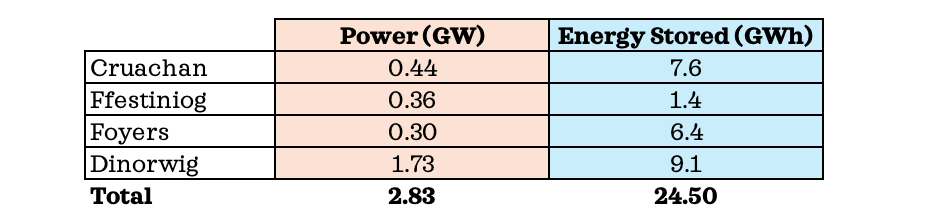
To give some context, UK electricity consumption was about 319 TWh in 2024, which equates to average power demand of about 36.4 GW.1 Thus the hydro storage facilities can deliver about 8% of the UK’s average power requirement and around 40 minutes of electricity storage. Intuitively this suggests our current PSH capacity is likely to be very useful for dealing with big intraday variations in power demand, but less helpful for any kind of long term shortfall. In Mackay’s language, PSH is great at dealing with slew (rapid changes in electricity supply or demand) but less helpful in dealing with lulls (a sustained period of lower renewable output)
It is encouraging that there is the potential for a lot more PSH in the UK. A November 2025 brochure from the British Hydropower Association summarises 14 projects with nearly 11 GW of potential power output and around 230 GWh of storage.
Some large individual projects have passed on to the project assessment stage of OFGEM’s cap and floor regime for long duration electricity storage - the five PSH projects include Coire Glas (c. 1.45 GW and 30 GWh) and Earba (c. 1.8 GW and 40 GWh)
How does it work?
PSH is a well proven and relatively simple technology which can achieve a round-trip efficiency of between 70 – 80%. There are four main components involved in a PSH plant:
Reservoirs
Piping
Powerhouse
Grid connections
Depending on the source of the water, PSH plants can be classified as either open-loop or closed-loop. In an open-loop system, such as Foyers, one of the reservoirs is connected to a naturally occurring river or lake. In a closed-loop system, such as Dinorwig, the reservoir is independent from any naturally occurring rivers or lakes. The water in the reservoirs of a closed loop system may need topping up due to losses from evaporation.
Within the powerhouse, typically there is a reversible generator assembly, usually a Francis turbine, which can act both as a pump, when storing energy, and a generator when discharging. There are three main technologies:
Fixed speed – where the pump and generator assemblies operate at a fixed synchronous speed.
Variable speed – where the pump and generator assemblies can operate at variable speed ranges. This allows the power demand and generation to be varied, improving efficiencies and frequency regulation services.
Ternary – two separate pump and generator assemblies connected to a single shaft. This allows rapid changing of operation modes, improved efficiencies and higher system inertia.
A drawback of PSH plants is their lack of locational flexibility - they require the presence of two close together reservoirs separated by a significant height difference.
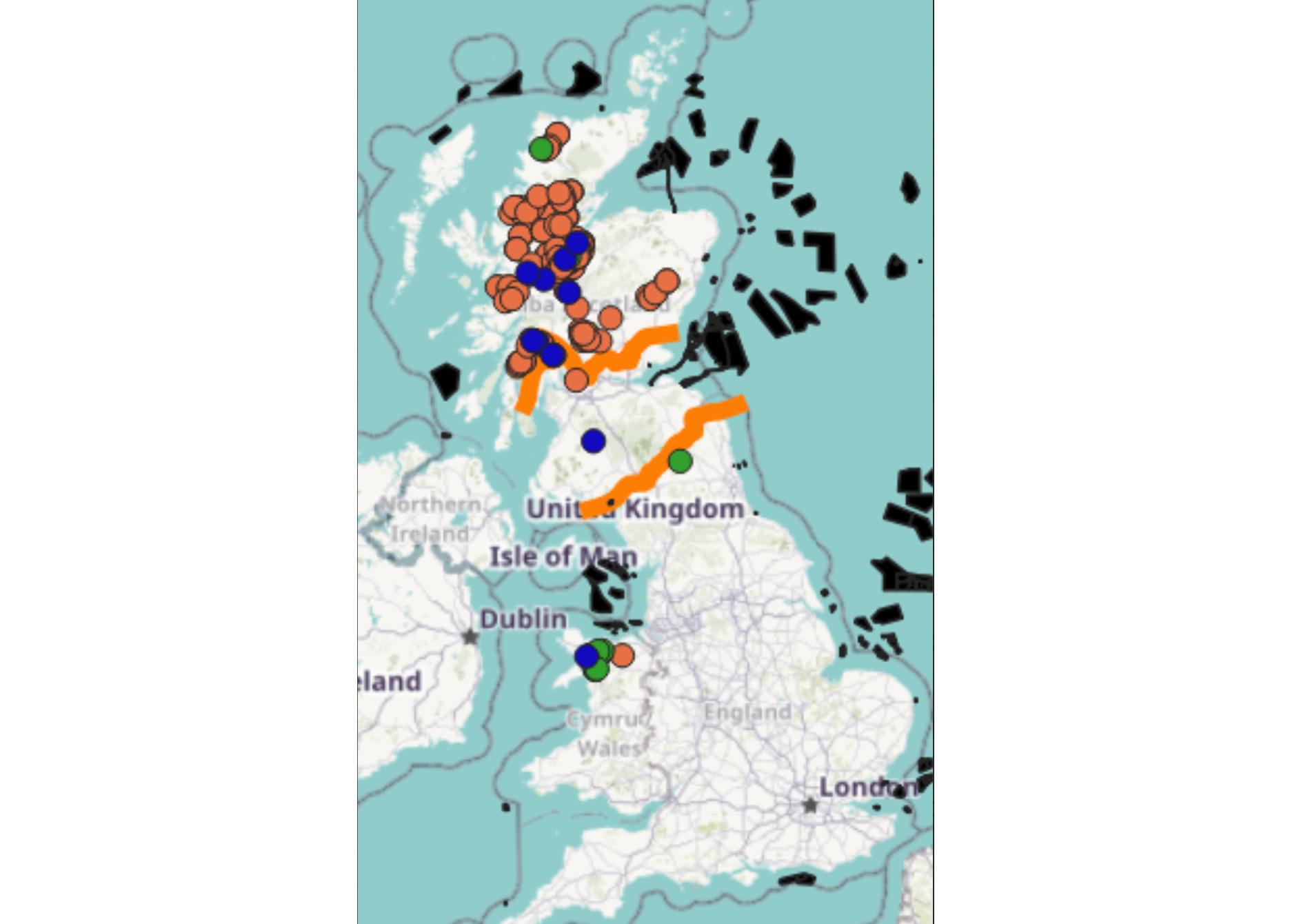
Looking at a map of the UK with existing and potential PSH sites plotted on it, the vast majority of potential sites are in northern Scotland, above the B4 and B6 transmission boundaries (thick orange lines) with a scattering of sites in North Wales. Offshore wind farm lease areas are shown in black.
History of PSH
PSH is the most globally proven and longest standing form of electricity storage. As of 2024 it accounted for 61% of global storage power capacity (GW terms). Batteries are rapidly catching up and forecast to overtake in terms of power output within the next two years.
The first PSH plants were developed in 1907 in Switzerland at Engeweiher. Reversible pumps and turbines were introduced in the 1930s and since then, global PSH deployment is now at approximately 189 GW. China currently has the largest deployment of PSH at 58.7 GW, a further 200 GW under construction or approved and has the largest development at Fengning PSH station which has a capacity of 3.6 GW and 40 GWh.
In terms of the UK’s history with the technology, Ffestiniog was opened in 1963, Cruachan in 1965, Foyers in 1975 and Dinorwig in 1984. Thus the UK hasn’t completed a meaningful PSH project for over 40 years.
Economics of PSH
PSH projects have large upfront costs, long payback periods and long project lead times. However, they have significant lifespans (>50 years) and relatively low OPEX.
The British Pathé film above references 1500 tunnelers working on the Cruachan project over 6 years. It also states that “At £14m, Cruachan cost much more than thermal power stations, but the running costs will be very much lower” This feels like a classic high capex, low opex, long duration asset that will be very sensitive to the cost of finance to build it.
In a modern UK context, there are a number of revenue mechanisms for PSH:
Energy arbitrage on the wholesale market and balancing mechanism
Contracts on the capacity market
Provision of ancillary services such as frequency response, reserve and black start services.
Further PSH investment could be a useful addition to the UK electricity system, but high up-front capital costs and the potential for sites to be superseded by falling battery costs create significant uncertainty for prospective capital providers.
In an attempt to reduce revenue uncertainties for developers, OFGEM have introduced a cap and floor scheme for Long Duration Electricity Storage (LDES). The cap and floor mechanism is a revenue support system, which has already been demonstrated on the UK’s interconnector projects. If the returns for an asset owner drop below a “floor”, then they will receive a payment to make up the difference, likewise if the returns exceed a “cap” then the profits above this level are returned.
OFGEM published their LDES Eligibility Assessment Outcome in September 2025.
171 projects applied for assessment, with 77 projects meeting the criteria set out by the “Eligibility Criteria Assessment Framework” (ECAF). ECAF consists of seven criteria - deliverability, grid connection offer, planning consent, minimum capacity, duration (at least 8 hours at full power), technological readiness and additional capacity in the case of expansion projects.
Five PSH projects, totalling 4.6 GW of power output and c. 75 GWh, made it through to the next stage of eligibility assessment. These projects are Coire Glas, Earba, Glenmuckloch, Loch Kemp and Loch na Cathrach. All five are based in Scotland.
We can also look at where PSH projects have grid connection agreements in place - using NESO’s Transmission Entry Capacity register. Some sites have phased grid connection offers - in these cases I have chosen the date of the latter project stage, which represents the connection date for full output.
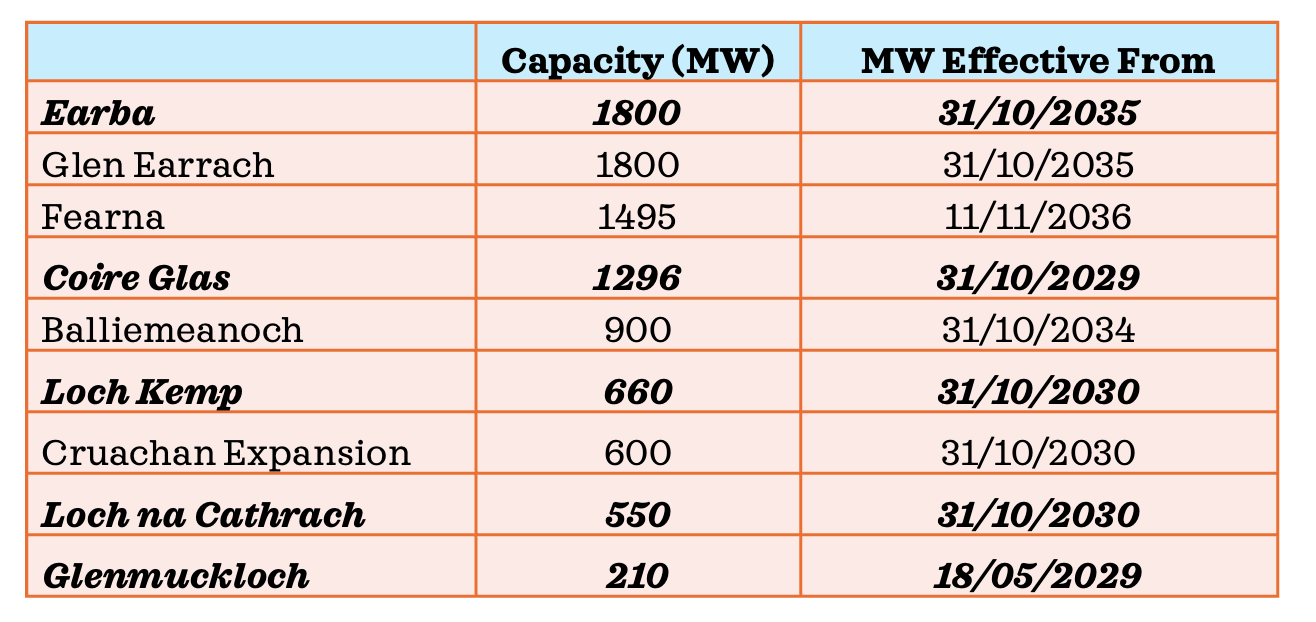
I also checked the Embedded Capacity Register for North Wales to see if there are any projects planning to connect at distribution level - the relatively small Glyn Rhonwy project (c. 100 MW and c. 700 MWh) was the only name that appeared.
Potential Benefits to the UK Energy System
Whilst PSH doesn’t add any electricity generation capacity, there are a few reasons that it could be helpful to the wider electricity system. I have yet to do any detailed analysis of PSH economics, so these are tentative thoughts.
Reducing wind curtailment or the need for transmission investment
It is clear that the majority of potential PSH sites are based in Scotland. We already have a problem with transmission constraints, particularly across the B4 and B6 boundaries that limit our ability to transfer electricity from Northern Scotland into England. Projects such as Eastern Greenlink 1 and 2 are designed to improve boundary capacity by building HVDC lines through the North Sea. Adding PSH capacity might help reduce the required transmission spend - by adding a storage buffer in Scotland, in theory you should be able to run the existing transmission lines at higher utilisation.
Making nuclear flexible
Nuclear power is often criticised for its lack of flexibility - but coupling PSH with nuclear should work out nicely for both technologies. A nuclear plant could run at max output, and use the ‘excess’ overnight power to pump water uphill, to be released during the day when demand is higher. This day-night cycle should be helpful for the economics of PSH, as its regularity should provide a lot of charge and discharge opportunities in a year to help recoup capital costs.
It is interesting that the SSE website mentions that Foyers was built to take advantage of surplus power from Hunterston B.
“It was intended that Foyers would make use of surplus electricity generated by Hunterston B nuclear power station in North Ayrshire, once the latter began operating in 1976.”
The SNP are opposed to new nuclear power, and building a new nuclear project behind a transmission constraint doesn’t feel all that sensible - but new nuclear projects such as Wylfa (Anglesey) might make potential PSH projects in North Wales more interesting.
Meeting the peak
The graph below displays some data for January 15th 2024, the day with the highest National Demand in 2024. The blue line represents national demand, and orange represents the behaviour of PSH. You can see that water was pumped up hill in the early hours (negative values) and was then used to generate electricity from around 3pm to 8pm to help meet peak demand.
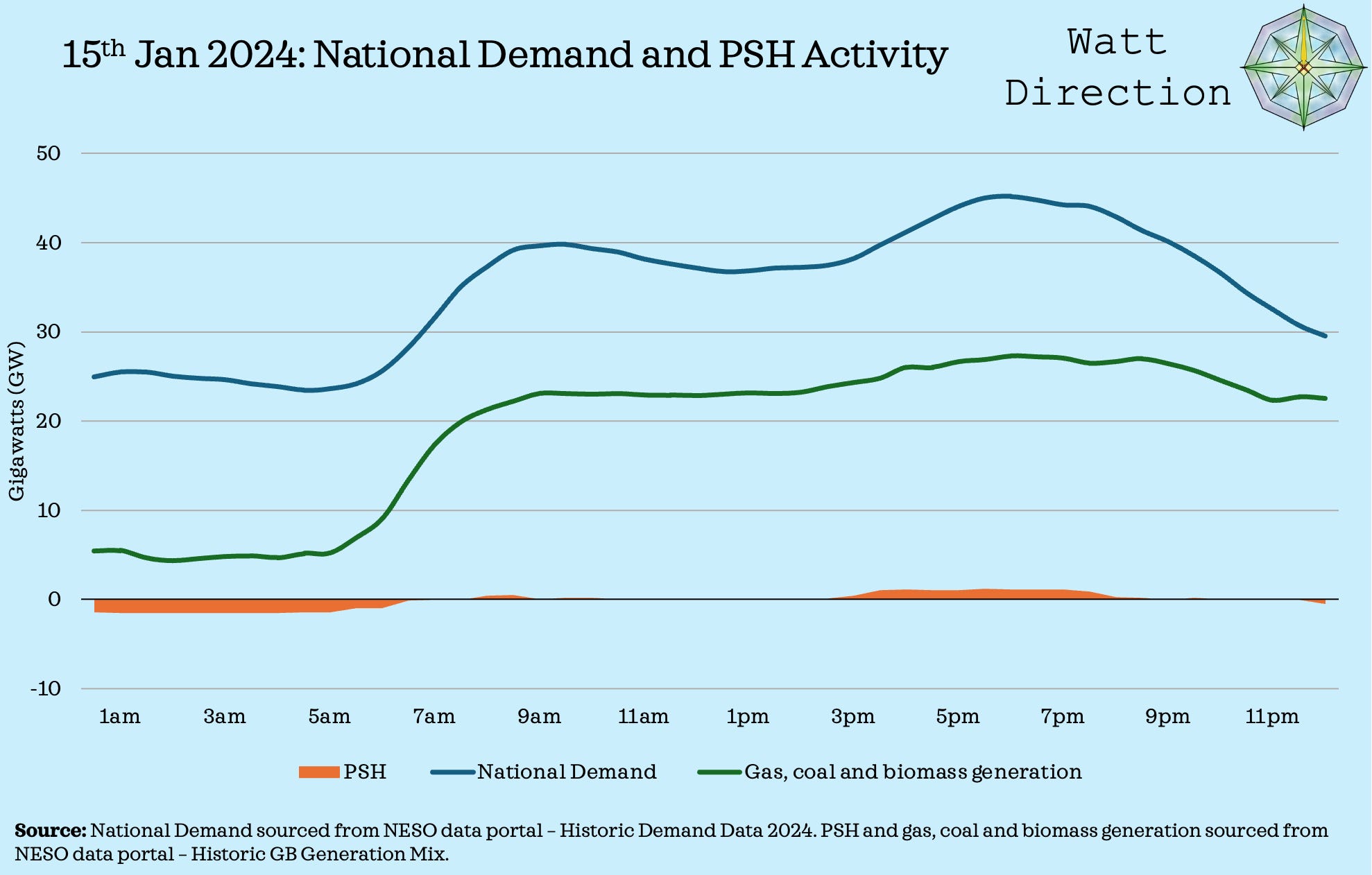
The green line represents dispatch from gas, coal and biomass plants. If the GB system had more PSH capacity, then we might get away with having less dispatchable thermal generation capacity. This could be achieved by running the dispatchable generators at a higher output level overnight, using the ‘excess’ generation to fill the upper reservoirs, and then using PSH to meet more of the afternoon/evening peak.
Essentially PSH helps transform a “meeting the peak” constraint to an “area under the curve” constraint.
This might improve the load factor and efficiency of the remaining thermal generation fleet. However, there are substantial energetic losses with this approach - not only the round trip losses from the pumps and turbines themselves, but also the transmission losses from shifting electricity from generation centres to PSH assets and then back to areas of high demand.
Concluding Thoughts:
I can’t help but be impressed by pumped storage hydroelectricity. I don’t fully know why - it might be the potential scale of these storage assets, or simply a warm fuzzy feeling of wanting to make use of parts of the UK with useful topographies.
There are a lot of ways in which PSH can be valuable to the grid, and I am glad we have the option to significantly expand both the power output and energy storage capacity of our PSH base. However, the case for expansion should to be justified on economic grounds rather than nostalgia - especially when battery costs have been declining and will have much more locational flexibility than PSH.
I hope to get stuck into the cost drivers in the New Year. Thank you for reading and Happy New Year!
Sourced from DUKES table 5.1 and quoted prior to losses in the electricity system.
If this govt was serious about Net Zero it would be 200% pushing PSH nothing else comes close to providing energy storage at scale that will be necessary.